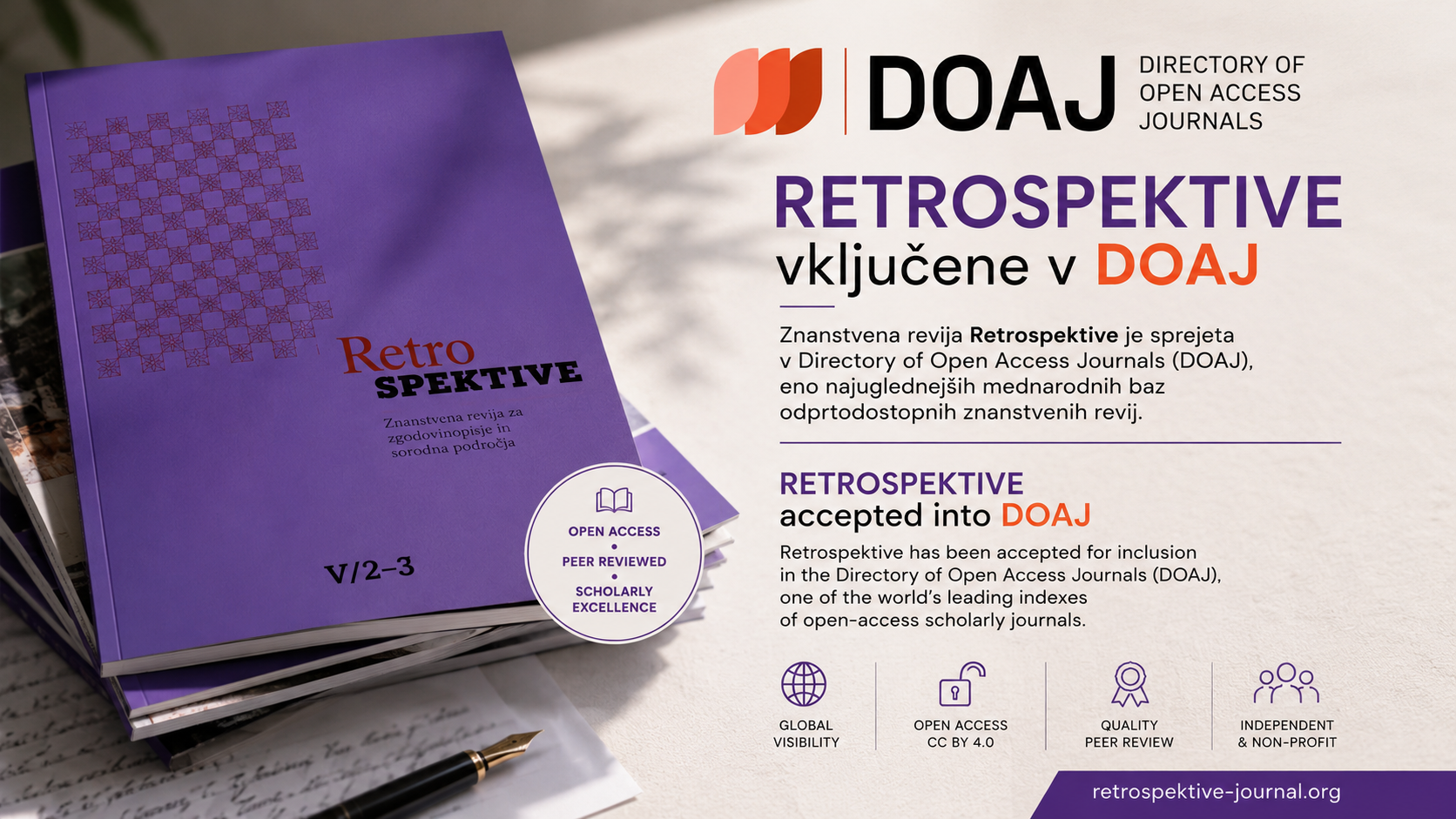
Izšla je nova tematska številka revije Retrospektive: The Ambivalence of Progress
Z veseljem sporočamo, da je izšla nova tematska številka znanstvene revije Retrospektive (letnik VIII, številka 2–3), posvečena vprašanju dvoumnosti napredka.
Številko je kot gostujoči urednik uredil asist. Robin Dolar, mladi raziskovalec na Oddelku za zgodovino Filozofske fakultete Univerze v Ljubljani in član programske skupine Slovenska zgodovina (P6-0235). Tematska številka je neposredni derivat doktorske in podoktorkse delavnice Dvoumnost napredka (The Ambivalence of Progress), ki je potekala 7. in 8. novembra 2024 v Ljubljani v okviru dejanosti programske skupine Slovenska zgodovina.
Prispevki v številki kritično obravnavajo idejo napredka kot enega temeljnih pojmov novejše zgodovine ter raziskujejo njegove protislovnosti, omejitve in družbene posledice, od ekonomskih in političnih struktur do vprašanj telesa, znanosti, tehnike in oblasti.
Vsebina številke:
– Tibor Rutar, Violence, Living Standards, and Inequality in Modern Times: Empirical Notes on Historical Progress
Avtor s pomočjo obsežnih kvantitativnih podatkov analizira dolgoročne trende nasilja, življenjskega standarda in neenakosti ter se kritično vključuje v razprave o t. i. »novih optimistih« in merljivosti zgodovinskega napredka.
– Robin Dolar, Historical Materialism and Progress
Članek obravnava razmerje med historičnim materializmom in idejo napredka ter analizira različne teoretske pristope k razumevanju zgodovinskega razvoja in družbenih sprememb.
– Augusto Petter, Ceremonies of Civilization: A Study on the Aesthetics of Progress in the Age of Comparisons
Prispevek raziskuje estetiko napredka v 19. stoletju ter pokaže, kako so podobe modernosti in civiliziranosti legitimirale politično oblast in zakrivale družbena protislovja.
– Julija Šuligoj, Scaling Boundaries: Women, Mountaineering, and the Historical Ambivalence of the Female Body
Avtorica analizira zgodovinske predstave o ženskem telesu skozi primer gorništva ter pokaže, kako so emancipacijski premiki pogosto spremljani z novimi oblikami nadzora in stereotipizacije.
– Miroslav Vašík, Student Reading Associations During Post-Revolutionary Neoabsolutism
Članek obravnava delovanje študentskih bralnih društev v času neoabsolutizma in razkriva preplet modernizacijskih teženj in represivnih politik.
– Sarah Lias Ceide, Technocracy, or: The Fluctuation of Western Imaginaries of Progress in the 20th Century
Avtorica ponuja pojmovno zgodovino tehnokracije ter pokaže, kako so predstave o znanstvenem in tehničnem napredku prisotne tudi v avtoritarnih in totalitarnih sistemih.
Tematska številka The Ambivalence of Progress prinaša interdisciplinaren in problemsko usmerjen vpogled v eno osrednjih vprašanj novejše zgodovine ter odpira prostor za nadaljnje razprave v zgodovinopisju in širših družboslovnih raziskavah.
Celotna številka je dostopna na: https://retrospektive-journal.org/revija/retrospektive-letnik-viii-stevilka-2-5/
A New Thematic Issue of the Journal Retrospektive has been Published: The Ambivalence of Progress
We are pleased to announce the publication of a new thematic issue of the scholarly journal Retrospektive (Volume VIII, Issue 2–3), dedicated to the question of the ambivalence of progress.
The issue was guest-edited by Assistant Robin Dolar, a young researcher at the Department of History, Faculty of Arts, University of Ljubljana, and a member of the research programme Slovene History (P6-0235). The thematic issue is a direct derivative of the doctoral and postdoctoral workshop The Ambivalence of Progress, held on 7–8 November 2024 in Ljubljana as part of the activities of the Slovene History research programme.
The contributions in this issue critically examine the idea of progress as one of the key concepts of modern history and explore its contradictions, limitations, and social consequences, ranging from economic and political structures to questions of the body, science, technology, and power.
Contents of the Issue:
• Tibor Rutar, Violence, Living Standards, and Inequality in Modern Times: Empirical Notes on Historical Progress
Drawing on extensive quantitative data, the author analyses long-term trends in violence, living standards, and inequality, and critically engages with debates on the so-called “New Optimists” and the measurability of historical progress.
• Robin Dolar, Historical Materialism and Progress
This article examines the relationship between historical materialism and the idea of progress, analysing various theoretical approaches to understanding historical development and social change.
• Augusto Petter, Ceremonies of Civilization: A Study on the Aesthetics of Progress in the Age of Comparisons
The article explores the aesthetics of progress in the nineteenth century and demonstrates how representations of modernity and civilization served to legitimize political power while concealing social contradictions.
• Julija Šuligoj, Scaling Boundaries: Women, Mountaineering, and the Historical Ambivalence of the Female Body
The author analyses historical representations of the female body through the case of mountaineering, showing how emancipatory advances were often accompanied by new forms of control and stereotyping.
• Miroslav Vašík, Student Reading Associations During Post-Revolutionary Neoabsolutism
This article examines the activities of student reading associations during the period of neoabsolutism, revealing the interplay between modernizing ambitions and repressive policies.
• Sarah Lias Ceide, Technocracy, or: The Fluctuation of Western Imaginaries of Progress in the 20th Century
The author offers a conceptual history of technocracy, demonstrating how ideas of scientific and technological progress were also present within authoritarian and totalitarian systems.
The thematic issue The Ambivalence of Progress offers an interdisciplinary and problem-oriented insight into one of the central questions of modern history and opens space for further debate within historiography and the broader social sciences.
🔗 The full issue is available at: